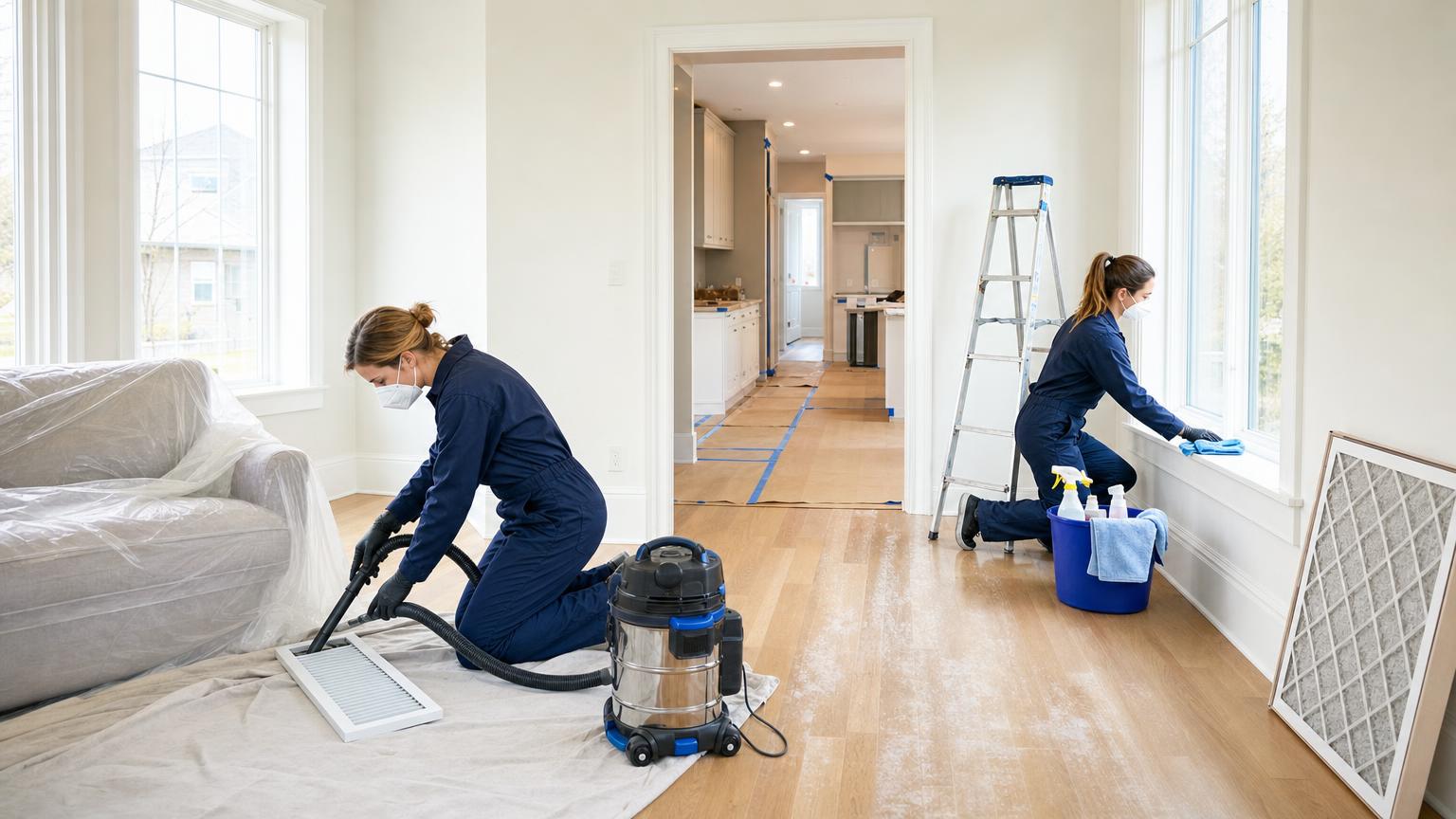

The renovation is finished. So why does your home still feel like a construction site?
Fine dust sits on every shelf. A faint chemical smell lingers near the new paint. However, your contractor says the job is done. This gap between "done building" and "ready to live in" is exactly where post construction cleaning Ottawa homeowners search for falls short of expectations.
In addition, many people assume post-construction cleaning and post-renovation cleaning are the same service. They are not always identical. Consequently, confusing the two can lead to a scope dispute with your contractor or an incomplete clean that leaves dust in your vents for months. This guide breaks down the real differences, so you can plan correctly and ask the right questions before you hire anyone.
TL;DR: Quick Summary
- Post-construction cleaning typically applies to new builds or major additions with raw, unfinished spaces full of fine dust and leftover materials.
- Post-renovation cleaning usually applies to updates inside an already-lived-in home, such as a kitchen or bathroom remodel, where dust control around existing furniture matters more.
- Fine drywall and sanding dust can travel into HVAC systems and vents, so this area deserves specific attention regardless of project type.
- Agreeing on a clear, written cleaning scope of work with your contractor before the project starts prevents disputes about who cleans what, and when.
Table of Contents
- What is the difference between post-construction and post-renovation cleaning?
- New Build Cleaning vs. Renovation Cleaning in Ottawa
- How long after renovation should you deep clean your house?
- Why does fine dust after renovation matter for your health?
- Removing Drywall Dust From Vents and HVAC Systems
- Is post-renovation cleaning safe to do yourself?
- How do you set a clear cleaning scope of work with a contractor?
- Post Construction Cleaning Checklist: What to Verify Room by Room
- Removing Hazardous Debris After Renovation
- How to Compare Post Construction Cleaning Quotes in Ottawa
- Frequently Asked Questions
- Key Takeaways
What is the difference between post-construction and post-renovation cleaning?
Post-construction cleaning generally refers to cleanup after a new build or a large-scale project, while post-renovation cleaning refers to cleanup after updates inside an existing, often still-furnished, home. The two share many tasks, but the starting condition of the space is different.
With new construction, the space is usually empty. There is no furniture to protect, but there is often more raw material residue: concrete dust, caulking smears, sticker residue on new windows, and stray screws or nails. Therefore, the cleaning process tends to move through the entire structure, top to bottom, treating every surface as untouched.
With a renovation, your home already has a kitchen full of dishes, a living room with a couch, and bedrooms with closets. As a result, the cleaning challenge shifts. The crew must work carefully around existing belongings while still removing fine dust that has drifted well beyond the renovated room. A single bathroom remodel, for example, can leave a dust film in the hallway, the room next door, and sometimes upstairs.
Both situations call for more than a regular tidy-up. If you want to understand how either of these compares to a standard clean, see this breakdown of a deep clean versus a regular clean for more context on where routine cleaning stops being enough.
New Build Cleaning vs. Renovation Cleaning in Ottawa
The table below compares common conditions found in each scenario. Use it as a starting point for a conversation with your contractor or cleaning provider, not as a fixed rulebook, since every project varies.
| Factor | New Build / Post-Construction | Renovation / Post-Renovation |
|---|---|---|
| Starting condition | Empty or near-empty space | Furnished, lived-in home |
| Common debris | Concrete dust, sawdust, packaging, sticker residue | Drywall dust, paint fumes, sanding residue |
| Dust spread | Contained mostly within the structure | Can travel into adjacent rooms and HVAC ducts |
| Protection needs | Minimal, since few items are present | Furniture, floors, and belongings need covering |
| Typical cleaning stages | Rough clean, then detail clean before move-in | Often a single thorough clean, sometimes staged by room |
Notably, neither scenario is automatically simpler than the other. A large new build has more square footage to cover, while a small renovation in an occupied home demands more precision to avoid disturbing existing furnishings.
How long after renovation should you deep clean your house?
A practical approach is to deep clean as soon as all dust-generating work, such as sanding, cutting, and painting, has fully stopped. Waiting longer only allows fine particles to settle deeper into carpets, vents, and soft furnishings.
For example, if your contractor finishes final touch-ups on a Friday, scheduling the deep clean for the following week gives dust time to settle from the air onto surfaces, where it can actually be captured and removed. On the other hand, cleaning too early, while sanding is still happening in another part of the home, wastes effort since new dust will resettle immediately.
In short, the right timing depends on your project's finish line, not a fixed calendar number. Confirm with your contractor exactly when all dust-producing tasks are complete before booking a cleaning appointment.
Why does fine dust after renovation matter for your health?
Fine dust from drywall, sanding, and cutting can linger in the air and settle on surfaces throughout your home, not just in the renovated room. This matters because thorough removal, rather than surface wiping, is what actually clears it from your living space.
Homeowners sometimes assume that a quick wipe-down handles the problem. However, fine construction dust is often much smaller than typical household dust. It settles slowly, which means it can resurface on furniture and floors for days after a visible cleanup appears complete.
If anyone in your household has asthma or other respiratory sensitivities, it is reasonable to ask your contractor or cleaning provider what dust-control methods they use, such as HEPA-filtered vacuums, before work begins. This is general information, not medical advice; speak with a healthcare provider about any specific health concerns related to dust exposure.
Removing Drywall Dust From Vents and HVAC Systems
Drywall dust and sanding debris can enter your HVAC system through return air vents and then circulate throughout the home every time the system runs. Addressing vents and ducts is therefore a key part of any thorough post-renovation or post-construction clean.
Here is a simple checklist for this specific area:
HVAC and Vent Dust Checklist
- Check whether return air vents were covered or sealed during the renovation. If not, assume dust has entered the system.
- Ask whether the furnace filter was changed before, during, and after the project. A clogged filter is a strong sign that dust has circulated widely.
- Request that vent covers be removed and wiped down, not just dusted from the outside.
- Ask your HVAC technician or cleaning provider whether a full duct inspection is warranted for larger renovation projects.
- Run the system briefly after cleaning and recheck surfaces nearby for any new dust settling.
Consequently, this step is often overlooked because vents are out of sight. Yet skipping it can mean dust keeps circulating weeks after the visible renovation mess is gone.
Is post-renovation cleaning safe to do yourself?
Light renovation cleanup, such as dusting shelves or vacuuming visible debris, can often be done safely yourself with basic precautions. However, larger projects involving significant dust, chemical residue, or hard-to-reach areas like ductwork are generally better suited to professionals with the right equipment.
Before deciding, ask yourself a few questions:
- Does the dust layer cover an entire room, or just a small area?
- Were any chemicals, solvents, or adhesives used during the project?
- Do you have access to a vacuum with proper filtration for fine particles?
- Is the mess limited to surfaces, or has it reached vents, light fixtures, and hard-to-access corners?
If your answers point to a larger, more complex job, bringing in a professional team makes sense. For smaller touch-ups, a regular cleaning routine paired with extra attention to dusty surfaces may be enough. For general guidance on keeping a home consistently clean between larger jobs, this piece on deep cleaning tips offers a useful starting point.
How do you set a clear cleaning scope of work with a contractor?
A clear scope of work means both you and your contractor agree, in writing, on exactly which cleaning tasks are included in the renovation contract and which are not. This single step prevents the most common disputes homeowners face at project completion.
Many contractors include a basic "broom clean" at the end of a job. This typically means sweeping floors and removing large debris, not a detailed clean of dust on surfaces, inside cabinets, or within HVAC vents. Therefore, if you expect a move-in-ready result, you need to specify that in writing before the project starts.
Questions worth asking your contractor directly:
- Does your quote include a broom clean only, or a detailed cleaning?
- Who is responsible for removing leftover materials, packaging, and debris bins?
- Will vents and ductwork be cleaned as part of the project, or is that a separate service?
- Is a professional post-construction cleaning service included, or will I need to arrange one separately?
Getting these answers in writing, as part of the signed contract or a separate addendum, protects both sides and sets realistic expectations.
Post Construction Cleaning Checklist: What to Verify Room by Room
A useful post construction cleaning checklist walks through each room and confirms that dust, residue, and debris have been addressed, not just visually, but thoroughly. Below is a practical starting framework.
Sample Room-by-Room Checklist
- Kitchens: Inside and outside of cabinets, countertops, backsplash grout lines, and inside the range hood.
- Bathrooms: Grout lines, inside vanity cabinets, around fixtures, and behind the toilet base.
- Floors: Baseboards, corners, and any transition strips between flooring types.
- Windows: Tracks, sills, and any adhesive residue from protective film or stickers.
- Light fixtures: Dust accumulation on fixtures and inside glass covers.
- Vents and registers: Covers removed, wiped, and reinstalled (see the HVAC section above).
- Closets and storage: Shelving, corners, and floor tracks for sliding doors.
Use this list to walk through the home with your contractor or cleaning provider before signing off on the project as complete. If any item fails a close inspection, flag it before final payment, not after.
Removing Hazardous Debris After Renovation
Renovation projects can produce debris that requires careful handling, such as sharp materials, broken glass, or leftover chemical containers. Consequently, general household cleaning tools are not always suited to this kind of debris removal.
Before any detailed cleaning begins, walk through the space and look for:
- Protruding nails, screws, or sharp metal edges.
- Broken glass or tile fragments.
- Leftover containers of paint, solvent, or adhesive.
- Loose wiring or exposed electrical components.
If you notice any of these, it is reasonable to ask your contractor to confirm the space has been cleared of hazards before a cleaning crew begins detailed work. Disposal of chemical containers and construction waste should follow your municipality's current waste disposal guidance, since rules can change and vary by material type.
How to Compare Post Construction Cleaning Quotes in Ottawa
Comparing quotes fairly means checking that each provider is quoting for the same scope of work, not simply comparing the bottom-line number. A lower quote that excludes vent cleaning is not necessarily a better deal than a higher quote that includes it.
When you request quotes, ask each provider the same set of questions:
- Does the quote include inside cabinets and closets, or surface areas only?
- Are windows, tracks, and sills included?
- Is vent and register cleaning part of the service?
- What equipment do they use for fine dust removal?
- Is the quote based on square footage, number of rooms, or an on-site walkthrough?
Request these answers in writing so you can place each quote side by side on the same basis. This approach protects you from comparing a basic clean to a detailed one without realizing it.
For readers weighing whether a professional team is worth the investment compared to handling it personally, this overview of the benefits of hiring professional cleaners outlines several practical considerations. You can also review a dedicated post construction cleaning service page or a post-renovation cleaning service page to see how each scope is typically structured.
Frequently Asked Questions
Do I need professional cleaners after a home renovation?
It depends on the scope of your project. Small touch-ups may be manageable yourself, but larger renovations involving significant dust or hard-to-reach areas, such as HVAC vents, often benefit from professional equipment and experience.
What is included in a post construction cleaning checklist?
A typical checklist covers cabinets, countertops, floors, baseboards, windows, light fixtures, vents, and closets, checking each area for fine dust and leftover residue rather than just visible mess.
How is new build cleaning different from renovation cleaning in Ottawa?
New build cleaning usually involves an empty space with raw material residue throughout, while renovation cleaning requires working carefully around existing furniture and belongings in a lived-in home.
Who is responsible for cleaning after a renovation, me or the contractor?
This depends entirely on what is written into your contract. Some contractors include only a basic broom clean, while others may offer a detailed clean as an add-on. Confirm this scope of work in writing before the project begins.
How do I find post construction cleaning services near me in Ottawa?
Look for providers who clearly describe their process for fine dust removal, vent cleaning, and room-by-room detail work. Request a written scope of work and compare it against the checklist outlined above before booking.
Key Takeaways
- Post-construction cleaning generally applies to new builds with empty, raw spaces, while post-renovation cleaning applies to updates inside a furnished, lived-in home.
- Fine drywall and sanding dust can travel into HVAC vents, so checking filters and vent covers is an important step regardless of project type.
- Deep cleaning is best scheduled once all dust-generating work has fully stopped, not before.
- A written cleaning scope of work with your contractor prevents disputes about broom cleans versus detailed cleans.
- When comparing quotes, confirm each provider is pricing the same scope, including vents, cabinets, and windows, before comparing cost.
- Hazardous debris, such as sharp materials or leftover chemicals, should be cleared before detailed cleaning begins.
A finished renovation should feel finished, not like a lingering construction zone. If you are ready to move past the dust and residue stage, request an estimate for a post-construction or post-renovation cleaning and ask the provider to walk through the room-by-room checklist with you before booking.


Leave a comment +
Leave a Reply
Your email address will not be published. Required fields are marked *